Last Updated: October 2026
Quick Answer: The best kitchen cabinets usually combine two materials: plywood for the cabinet boxes, because it is strong and handles moisture well, and MDF or solid wood for the doors, depending on whether they will be painted or stained. Melamine and thermofoil cost less but are harder to repair. In GTA homes, where humidity swings between seasons, painted MDF doors stay more stable than painted solid wood.
The best kitchen cabinet material depends on which part of the cabinet you mean. The box, the doors and the finish are separate choices, and the right answer is different for each. Plywood is the strongest choice for boxes, MDF gives the smoothest painted doors, and solid wood is best for stained doors and face frames.
In more than 30 years of building cabinets in our Thornhill woodshop, we have worked with every material in this guide. Most comparison articles are written by marketers; this one is based on what we see on our own shop floor and in kitchens we have installed across Toronto, Vaughan, Markham and Richmond Hill. Below, we compare each material on strength, moisture resistance, finish and cost, and explain what we build with and why.
Cabinet Box vs Cabinet Door: Two Different Choices
Every kitchen cabinet has two main parts, and they are often made from different materials.
- The box (or carcass): the sides, bottom, top and back that hold everything up. It needs strength, screw-holding power and moisture resistance, especially under the sink and dishwasher.
- The doors and drawer fronts: what you see. They need a smooth, stable surface that takes paint or stain well and doesn’t warp.
A quote that says “solid wood cabinets” or “MDF cabinets” can mean very different things. Always ask what the box is made of and what the doors are made of, separately.
Kitchen Cabinet Materials at a Glance
| Material | Best used for | Strength | Moisture resistance | Finish | Repairable | Relative cost |
|---|---|---|---|---|---|---|
| Plywood | Boxes, sink bases | High | Good | Usually covered with veneer or melamine | Yes | Medium–high |
| MDF | Painted doors, panels | Medium | Fair, poor if edges get wet | Excellent for paint | Somewhat | Medium |
| Particleboard | Budget boxes | Low | Poor | Covered with melamine | Rarely | Low |
| Melamine | Box interiors, budget doors | Medium (depends on core) | Fair at the surface, poor at edges | Fused colour or wood-look | Rarely | Low |
| Thermofoil | Budget painted-look doors | Medium | Good at the surface | Vinyl wrap, no paint | No | Low–medium |
| Solid wood | Stained doors, face frames | High | Moves with humidity | Excellent for stain | Yes, can be refinished | High |
| Wood veneer | Slab doors, panels | Medium–high | Good if sealed | Real wood grain | Somewhat | Medium–high |
MDF Kitchen Cabinets
MDF (medium-density fibreboard) is made from fine wood fibres pressed together with resin into dense, flat sheets. It has no grain and no knots, so it doesn’t expand and contract the way solid wood does.
That stability makes MDF the best material for painted doors. A one-piece MDF Shaker door has no joints between the frame and panel, so the paint doesn’t crack along the seams when the seasons change. It also gives a smooth, even surface for lacquer.
The weakness is water. Once water gets past the paint into an exposed edge, MDF swells and doesn’t recover. It is also heavy and holds screws less firmly than plywood, which matters for hinges on large doors. We use MDF for painted doors and panels, not for sink-base boxes.
We compared MDF and wood for bathrooms in our guide to MDF vs wood vanities; most of the same points apply in the kitchen.
Plywood Kitchen Cabinets
Plywood is made from thin layers of wood veneer glued together with the grain of each layer at right angles to the next. That cross-layering makes it strong, light for its strength and resistant to warping.
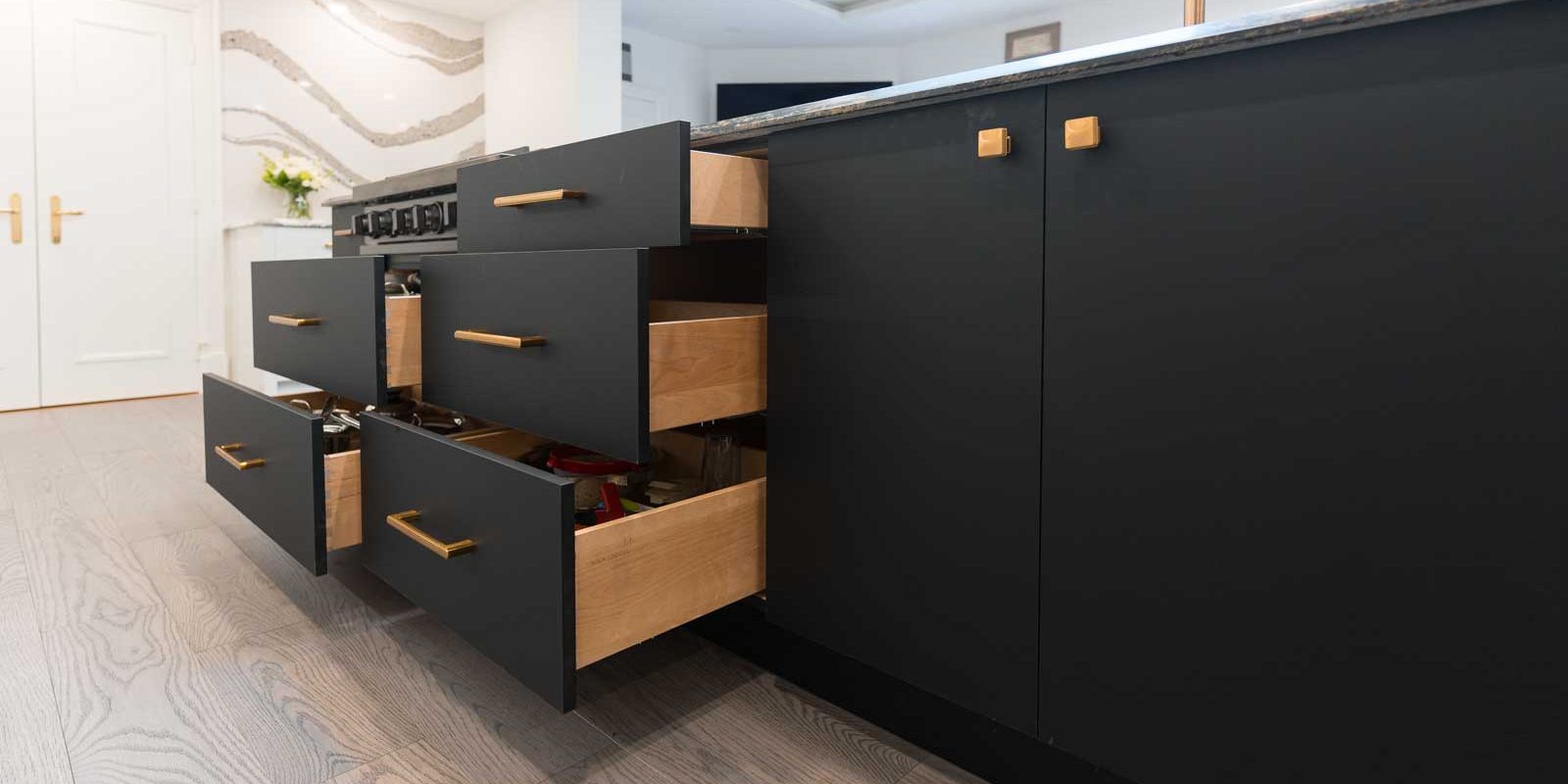
Plywood is the best material for cabinet boxes. It holds screws and hinges firmly, and it handles a small leak under the sink far better than MDF or particleboard. It also stands up to the bumps and weight of years of daily use.
The downsides are cost and surface. Plywood costs more than particleboard or MDF, and its surface isn’t smooth enough to paint well, so the visible sides of a cabinet are usually covered with wood veneer or a finished panel.
Plywood vs MDF Cabinets: Which Is Better?
Neither is better everywhere. Use each where it is strongest:
| Plywood | MDF | |
|---|---|---|
| Cabinet boxes | Best choice | Acceptable in dry areas |
| Sink and dishwasher bases | Best choice | Avoid |
| Painted doors | Not ideal (grain can show) | Best choice |
| Screw and hinge holding | Strong | Weaker |
| Weight | Lighter | Heavier |
| Cost | Higher | Lower |
Particleboard Cabinets
Particleboard is made from wood chips and sawdust bonded with resin. It is the least expensive cabinet core and is common in flat-pack and big-box cabinets, almost always covered with melamine.
It works in a dry room with careful use, but it is the weakest choice for a kitchen. Screws strip easily, shelves can sag under heavy dishes, and any water at an edge or a screw hole makes it swell and crumble.
Melamine Cabinets
Melamine is not a wood. It is a hard, resin-soaked paper that is heat-fused onto a core of particleboard or MDF. It comes in solid colours and printed wood grains, and the surface is durable and easy to wipe clean.
Melamine is a good choice for cabinet interiors, where it gives a clean, washable surface, and for budget or rental kitchens. Its weak points are the edges: they are covered with edge banding, and if that banding lifts or the surface chips, water reaches the core underneath. It also can’t be painted or refinished well, so a damaged melamine panel usually has to be replaced.
Thermofoil Cabinets
Thermofoil doors are MDF doors wrapped in a thin vinyl film that is heated and vacuum-pressed over the surface. The result looks like a painted door at a lower price, with no visible joints and a surface that is easy to clean.
The problem is heat. Near ovens, toasters, kettles and dishwashers, thermofoil can peel at the edges or yellow over time, and it can’t be repaired or repainted once it does. That is why thermofoil has fallen out of favour for full kitchens. If you choose it, use heat shields beside the oven and keep small appliances away from door edges. For a long-lasting painted look, painted MDF is the better investment.
Solid Wood Kitchen Cabinets
Solid wood cabinets use real boards of maple, oak, cherry or walnut for the doors and face frames. They are strong and beautiful, and they can be sanded and refinished many times over their life.
Solid wood moves with humidity, swelling slightly in summer and shrinking in winter. That is not a defect, but it matters for painted doors: on a five-piece painted Shaker door, the movement can open hairline cracks in the paint at the joints. That’s why we usually recommend solid wood for stained or natural finishes and MDF for painted ones. Solid wood is also the most expensive option.
Wood Veneer Cabinets
Wood veneer is a thin slice of real hardwood bonded to a stable core of MDF or plywood. It gives you the grain of walnut, white oak or rift-cut oak with far less movement than solid boards, which makes it ideal for flat slab doors in European Modern kitchens and for matched grain across a run of cabinets. Our two-tone kitchen cabinets guide shows how veneer and painted doors work together.
How GTA Humidity Affects Cabinet Materials
GTA homes go from very dry air in winter, when the furnace runs for months, to humid summers. Every wood-based material reacts to that swing, but not equally. Solid wood moves the most, plywood very little, and MDF almost not at all.
In practice, this means painted solid-wood doors are the most likely to show hairline cracks at the joints after a few winters, while painted MDF doors stay crisp. Keeping indoor humidity steady with a humidifier in winter helps every material last longer.
Formaldehyde and Indoor Air
MDF, plywood and particleboard are made with resins, and some can release small amounts of formaldehyde. Since January 2023, composite wood products made or imported for sale in Canada must meet emission limits under the Formaldehyde Emissions from Composite Wood Products Regulations. When comparing quotes, ask whether the sheet materials are certified to these limits.
What We Build With, and Why
After decades of building and replacing kitchens, this is our standard:
| Part | Our standard material | Why |
|---|---|---|
| Cabinet boxes | Plywood | Strength, screw holding, handles moisture |
| Painted doors | MDF | Stable, smooth, no cracking at joints |
| Stained doors and face frames | Solid maple, oak or walnut | Real grain, can be refinished |
| Slab and wood-grain doors | Wood veneer on a stable core | Matched grain, minimal movement |
| Interiors | Light, washable finish | Easy to clean, brightens the inside |
Because every cabinet is built in our own woodshop, you can change any of these choices for your project, and we’ll explain the trade-off honestly. For how custom compares with factory-made cabinets, see our guide to custom vs stock cabinets.
Matching Materials to Your Kitchen Style
- Classic kitchens: stained solid cherry, maple or oak doors with raised panels and face frames.
- Transitional kitchens: painted MDF Shaker doors, often with a stained wood or veneer island.
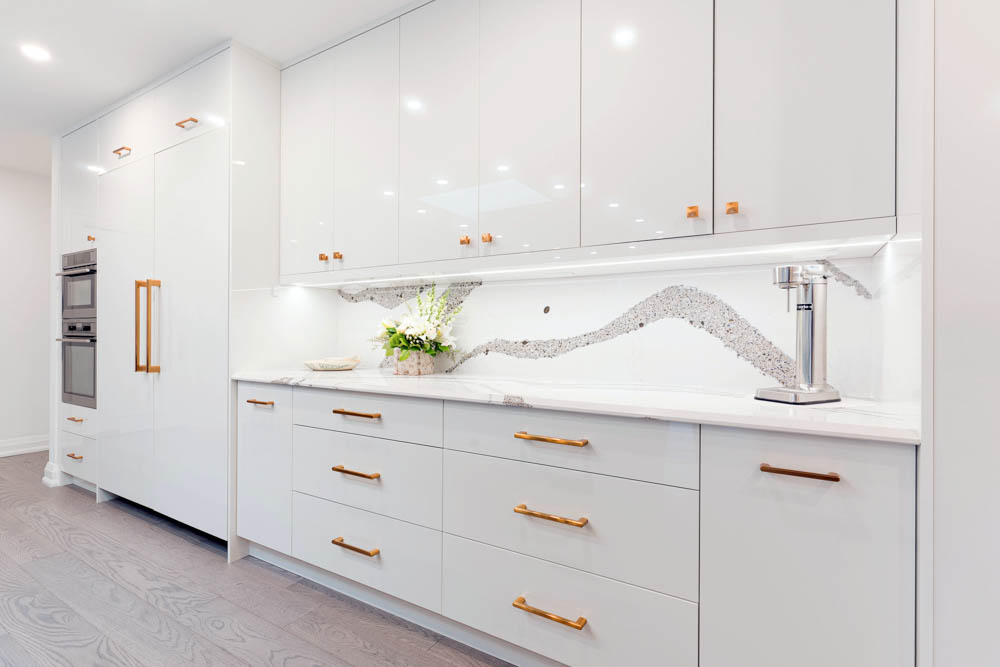
- European Modern kitchens: flat slab doors in wood veneer, high-gloss lacquer or matte painted MDF, often frameless with integrated pulls.
How to Choose Kitchen Cabinet Materials: 5 Steps
- Separate the box from the doors. Decide on the box material first, then the doors.
- Protect the wet zones. Use plywood for the sink base and the cabinets next to the dishwasher.
- Choose painted or stained. Painted doors work best in MDF; stained doors work best in solid wood or veneer.
- Think about heat. Avoid thermofoil next to the oven, cooktop and toaster.
- Compare quotes the same way. Ask every company for the box material, door material, finish and edge treatment in writing.
For a wider look at buying cabinets in the city, see our guides to kitchen cabinets in Toronto and custom kitchen cabinets in 2026.
Frequently Asked Questions
What is the best material for kitchen cabinets?
For most kitchens, plywood boxes with MDF doors for a painted finish, or solid wood doors for a stained finish. This combination gives strength where it matters and a stable, smooth surface where you see it.
Is plywood better than MDF for kitchen cabinets?
Plywood is better for cabinet boxes, especially under the sink, because it is stronger and handles moisture better. MDF is better for painted doors because it doesn’t move with humidity and gives a smoother finish.
Are melamine cabinets good quality?
Melamine is durable and easy to clean, and it works well for cabinet interiors and budget kitchens. Its weak points are chipped edges and water reaching the particleboard core, and it is hard to repair once damaged.
Do thermofoil cabinets peel?
They can. Heat from ovens, toasters and dishwashers can make the vinyl film peel or yellow at the edges over time, and it can’t be repaired. Heat shields and careful placement help, but painted MDF lasts longer.
Are solid wood cabinets worth the cost?
For stained or natural finishes, yes: solid wood looks beautiful and can be refinished for decades. For painted doors, MDF is usually the better choice, because solid wood’s seasonal movement can crack the paint at the joints.
What materials do custom cabinet makers use?
It varies, so always ask. At Joseph Kitchen & Bath, our standard is plywood boxes, MDF for painted doors, and solid wood or wood veneer for stained and wood-grain doors, all built in our Thornhill woodshop.
Conclusion: Our Recommendation
For most GTA kitchens, choose plywood cabinet boxes, especially for the sink and dishwasher bases, and match the doors to the finish: MDF for painted doors, solid wood or wood veneer for stained and natural wood. Use melamine for interiors, and avoid thermofoil near heat. Most importantly, compare quotes by asking what the box and doors are each made of, in writing.
At Joseph Kitchen & Bath, we build every cabinet in our own Thornhill woodshop, so you can see and touch each material before you decide. Homeowners across Thornhill, Toronto, Vaughan, Markham, Richmond Hill and North York trust our team to design, build and install their kitchens. Learn more about our kitchen renovation services.
Book Your Free In-Home Consultation
The right materials depend on your kitchen, your style and your budget. A free in-home consultation gives you an accurate estimate for your space, and you can visit our showroom to see door samples and cabinet boxes side by side. Book your free in-home consultation or call (905) 707-7756.
About the Author — Joseph Darvish, Founder & Lead Designer, Joseph Kitchen & Bath. Joseph Darvish is a kitchen remodel expert and the founder of Joseph Kitchen and Bath. With over 30 years of experience in custom cabinetry and full-service renovation, he personally leads every project from design through installation at his Thornhill, ON showroom and woodshop.
Instagram | Facebook | About Us
Produced by: Joseph Kitchen & Bath.
Disclaimer: The information presented here is intended as general advice only. For exact pricing tailored to your specific needs, it is essential to seek guidance from a qualified expert.